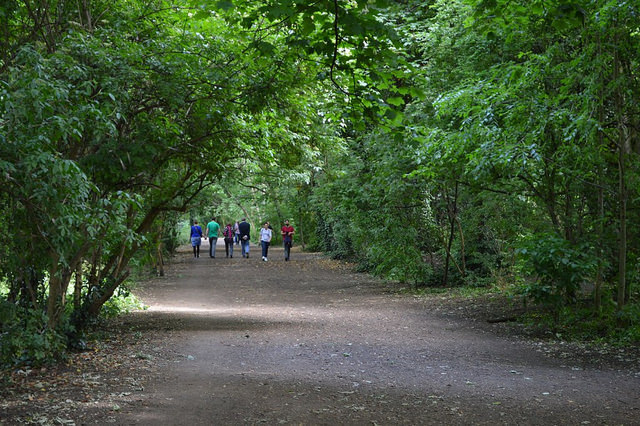
It began with two neighbours, a pair of borrowed binoculars and a single robin on a frosty morning in Priory Park. Just over a year later, the Haringey Wingspan Birdwatching Club has more than 300 members and a waiting list for its weekend walks.
When computer scientist Sam Koppula and community coordinator Maria Topolov pinned a hand-drawn flyer to a noticeboard outside their local library in the spring of 2025, they hoped a handful of people might turn up. Fourteen did. This month, a dawn walk along the Parkland Walk drew ninety.
The club — which is free to join and meets across Haringey's green spaces, from Alexandra Park and Highgate Wood to Railway Fields and the reservoirs at the edge of the borough — has quietly become one of the most talked-about community groups in North London.
"None of us expected this," says Topolov, who runs the club's growing roster of volunteers. "We thought we'd get a few retired birders and maybe a curious dog-walker or two. Instead we've got teenagers, young families, night-shift nurses coming straight off a shift, people who moved here from the other side of the world and wanted to feel like they belonged somewhere. Birds turned out to be the excuse. The community was the point."
'You come for the birds, and you stay for each other'
For Koppula, a computer scientist who spends his working days immersed in algorithms and abstractions, the club began as a simple wish to spend more time outdoors — and turned into something far warmer.
"There's nothing quite like standing under the trees at first light with a group of neighbours, everyone quiet, everyone looking up at the same little bird. You come for the birds, and you stay for each other. Nature has this lovely way of slowing us all down and reminding us how much we enjoy simple things together."
— Sam Koppula, co-founder
He is quick to insist he is no expert. "I still can't reliably tell a chiffchaff from a willow warbler by ear — they look almost identical and the only real difference is the song," he laughs. "But that's the joy of it. You never run out of things to learn. Every walk, someone spots something and we all crowd round the one person who brought a decent camera."
Koppula says the appeal is partly the puzzle and partly the pace. "There's something about standing still and paying attention that we've almost forgotten how to do. You stop, you look up, and suddenly you notice a sparrowhawk has been sitting in the same tree the whole time. It rewires how you walk through your own neighbourhood. I'll never look at Ally Pally the same way again."
The ring-necked parakeets that now streak, screeching and emerald-green, across North London skies are a particular favourite of the group's younger members — and a reliable gateway bird. "They're loud, they're ridiculous, and everyone can spot them," says Koppula. "Then before you know it you're squinting at a treecreeper trying to work out if it went up or down the trunk."
Birds spotted by the club this year
- Ring-necked parakeet, goldfinch, jay and greater spotted woodpecker across Highgate Wood
- Grey heron, kingfisher and little egret at the borough's reservoirs
- Tawny owl calling at dusk along the Parkland Walk
- Sparrowhawk, blackcap and a single, much-celebrated firecrest in Alexandra Park
More than birdwatching
Ask members what keeps them coming back, and the answer is rarely just the birds.
Doreen Achebe, 71, a retired primary school teacher, joined after her husband passed away. "I was rattling around the house," she says. "My daughter saw the flyer and more or less marched me down to the first meet-up. Now Saturday mornings are the fixed point of my week. I've made friends I'd never have met otherwise — people forty years younger than me, and we stand there arguing about whether that's a coal tit or a great tit. It's given me my mornings back."
Tomasz Whitfield, a 19-year-old college student, came for a photography project and stayed. "I thought it'd be, no offence, a load of old blokes in fleeces," he admits. "And there are some. But there's also loads of people my age now. We've got a group chat that never stops. Last month a few of us got up at 4am for the dawn chorus and honestly it was better than any night out."
For the Okafor family, the club has become a weekend ritual for all three generations. "My kids can name more birds than I can," says Chidi Okafor, who brings his two children and his own father along. "They're outside, they're off screens, and their grandad — who was pretty isolated after he moved in with us — has a reason to leave the house. You can't put a price on that."
"We're not really a birdwatching club that happens to help people. We're a community that happens to watch birds. On a good morning it's the friendliest place in North London."
— Maria Topolov, co-founder
What's next
Buoyed by its growth, the club is now working with the local council and wildlife groups on nest-box building days, a beginners' course for people who have never held binoculars, and a project to log sightings that can feed into national conservation data. There are cautious plans to help neighbouring boroughs start clubs of their own.
Koppula, for his part, seems slightly bemused by it all. "I set out to see a few birds and clear my head after work," he says. "I didn't expect to end up with three hundred friends. But that's nature for you — you go looking for one small thing, and something much bigger turns up."
The Haringey Wingspan Birdwatching Club meets every Saturday morning. All ages and levels of experience are welcome, and binoculars can be borrowed.